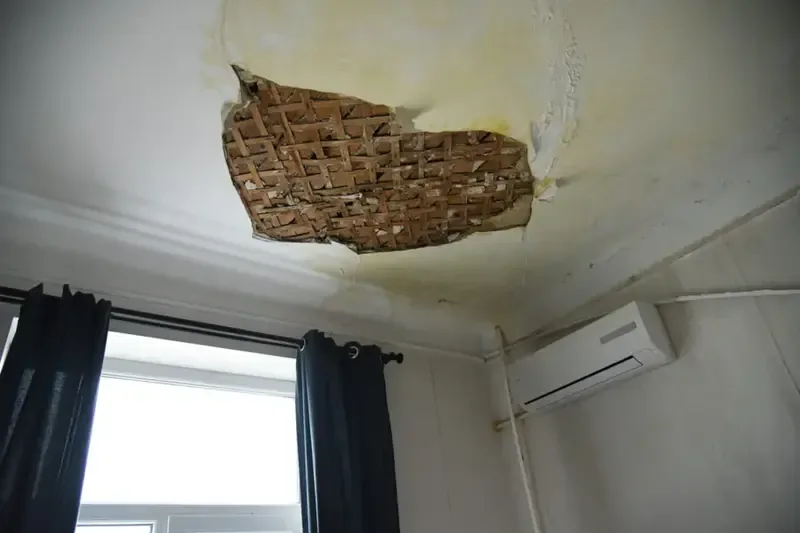
The City of Boston Open Space Plan calls West Roxbury the most suburban of Boston's neighborhoods, with an abundance of single-family homes and backyards. But City of Boston Assessing records for July 2011 also counted 950 two-family properties, 97 three-family properties and 1,732 condominium units, and in those buildings an upstairs leak lands on someone else's ceiling.
Key takeaways
- Single-family homes dominate West Roxbury, but 2011 records counted 950 two-family properties, 97 three-family properties and 1,732 condominium units, where one leak can reach a neighbor.
- Common sources are appliance supply hoses, toilets and tubs, and failures in the plumbing inside walls and floors.
- The unit with the leak shuts off the source first, and the unit below protects belongings and watches the ceiling.
- Both units are dried on their own moisture readings, because a dry ceiling can hide a wet cavity.
- Photographs, a shared list of damaged items and early notice to the owner or association keep a claim clear.
Where an upstairs leak can reach a neighbor
City of Boston Assessing records for July 2011 counted 6,549 single-family properties, 950 two-family properties, 97 three-family properties and 1,732 condominium units in West Roxbury.
The two-family, three-family and condominium buildings are the places where a leak in an upper unit can reach the unit below. Single-family owners face the same sources, but the water stays in one household.
Common sources of an upstairs leak
Slow leaks hide the longest. Water can travel along a joist and appear far from the source, so a stain on a ceiling is not always directly under the leak.
- A washer or dishwasher supply hose that splits or pops off.
- A toilet supply connection, a tank or a tub overflow.
- A supply or drain pipe inside a wall or floor.
- A shower pan or tub seal that has failed.
- A water heater tank or fitting in an upper-floor closet.
How far a ceiling leak can travel
Water follows the easiest path. It can run along a pipe, across a joist and down a wall cavity before it shows as a stain.
That is why moisture readings are taken well beyond the visible mark, in the ceiling, the walls on both sides and the floor of the unit above.
- Along pipes and through the holes cut for them.
- Across the tops of walls and into the next room.
- Down inside a wall cavity to the baseboard.
- Into light fixtures and ceiling fans.
What each household does first
The two units have different jobs, and each one should start at once.
In the unit with the leak
The goal is to stop the source and keep the water from spreading across the floor.
- Close the fixture's shutoff valve, or the unit's main valve.
- If the water will not stop, close the building's main shutoff or ask the owner or association to do it.
- Soak up standing water with towels and move rugs and furniture off wet floors.
- Photograph the source and the wet areas.
In the unit below
The goal is to protect belongings and keep the ceiling from falling.
- Move belongings away from the wet ceiling.
- Place plastic sheeting or a bucket under drips.
- Do not poke a bulging ceiling, because it can release a lot of water at once.
- Leave wet ceiling lights and fans switched off.
- Photograph stains as they spread.
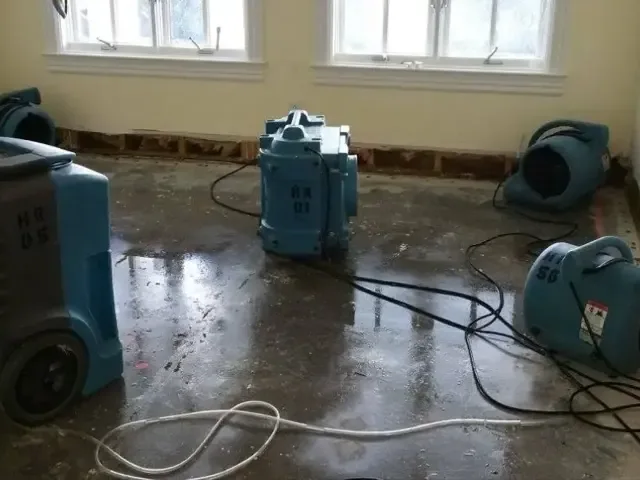
Extraction and drying for both units
Standing water on the upper floor is removed first, then water that has dripped or run into the lower unit. The extraction crew uses compact tools that fit around furniture and stairs.
The approach is covered under water extraction.
Carpet and pad in the lower unit are often removed if they stayed wet, while hard floors can be dried in place.
A leak does not stop at the ceiling. Water can sit in the joist bay between the two units, in the wall cavity and in the floor system above.
The restoration team measures moisture in both units, opens the ceiling where water is trapped and sets drying equipment on each side. The readings decide when drying is done.
The steps appear under ceiling leak water damage and, for hose and appliance sources, appliance leak water damage.
In a condominium building, shared walls and ceilings mean the drying team may need access to a third unit. Access is easier when the owner or association is told early.
- Ceiling drywall or plaster: opened where it holds water.
- Insulation in the cavity: removed if wet.
- Cabinets, subfloor and hardwood: checked, then dried or replaced.
- Walls shared between units: checked for moisture on both faces.
Telling the neighbor, the owner and the association
A leak in a condominium or a two-family home often involves more than one person. The household with the leak should tell the unit below right away, then the owner, the property manager or the condominium association.
Building rules and insurance policies differ, so a written record helps everyone.
- The date and time the leak was noticed.
- Photographs from both units.
- A list of damaged items with rough values.
- Moisture readings and the dates drying equipment was set and removed.
Preventing a repeat
Most upstairs leaks come from parts that wear out, such as hoses, valves and seals. A yearly check of the washer hose, the dishwasher connection and the toilet supplies is a small job.
Local service details are collected on the West Roxbury water damage pages.
- Replace rubber hoses before they bulge or crack.
- Know where each shutoff valve is and test it.
- Use a drain pan under a washer on an upper floor.
Questions
Why does a ceiling stain not sit under the leak?
Water follows joists, pipes and gaps, so it can travel before it drips. The stain shows where the water finally escaped, not always where it started.
Who pays when an upstairs leak damages the unit below?
That depends on the cause, the building rules and the insurance policies involved. Written records of the source, the damage and the dates make the conversation easier.
Should the ceiling below be opened?
A ceiling that holds water may need to be opened in a controlled way to release it and let the cavity dry. The restoration team decides this from moisture readings.
Can both units be dried at the same time?
Yes. Each unit gets its own equipment and its own readings, and drying continues until both meet the dry reference.
What if the leak is a water heater?
A tank failure can release a lot of water at once. Shut off the supply to the tank, move belongings and begin extraction quickly.
Does a small leak need professional drying?
Even a small leak can leave moisture in a ceiling cavity or under flooring. Readings show whether materials are dry, and a surface that feels dry can still be wet inside.