Structural Drying and Dehumidification in Jamaica Plain, MA
After the water is extracted, the drying team in Jamaica Plain pulls the moisture still inside framing, subfloor, plaster and masonry, using air movers and LGR dehumidifiers, and logs readings until every material reaches its dry goal.
(888) 480-6221Water is out, walls still wet? Plan the drying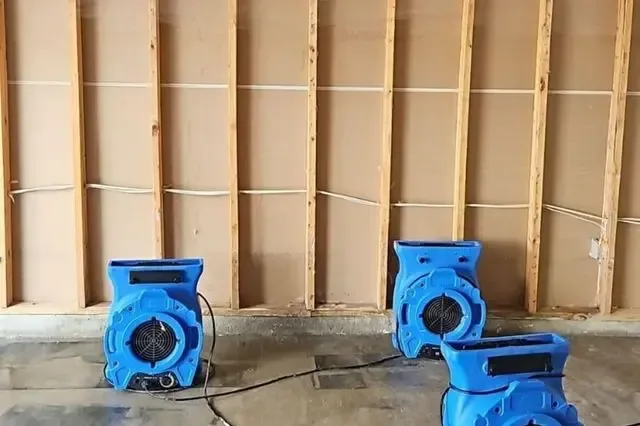
First steps for structural drying and dehumidification in Jamaica Plain
- Leave equipment running. Air movers and dehumidifiers work around the clock; keep them on.
- Keep windows shut. Humid outside air slows drying unless the tech says otherwise.
- Hold the heat steady. A warm, steady house dries faster than a cold one.
- Do not cover wet walls. No new paint or flooring until readings say dry.
How structural drying and dehumidification is handled, start to finish
Map
Readings in every wet material.
Set up
Size air movers and dehumidifiers.
Monitor
Log readings and adjust daily.
Confirm
Remove gear at the dry goal.
Extraction removes the water you can see. Structural drying removes the water you cannot: inside studs, under floorboards, in plaster and in basement concrete. The older houses here mix materials that dry at very different rates, from drywall that gives up water in days to plaster, oak strip flooring and fieldstone that hold it much longer, so drying is measured, not guessed.
How the drying is measured
- A moisture map on day one, with readings taken in every wet material
- A dry reference taken from the same material in an unaffected room
- Daily psychrometric readings: temperature, humidity and grains per pound
- Equipment removed when wet materials sit within 2 to 4 points of the reference
Walls and floors still wet after the cleanup? Drying runs 24/7.
(888) 480-6221Get the drying measuredClass of loss and equipment
The IICRC S500 standard sorts losses into Class 1 to 4 by how much water was absorbed and by which materials. Class 4 covers dense materials like plaster, hardwood and masonry that need lower humidity and more time. Air movers and LGR dehumidifiers are sized to the class, and walls are opened only where readings show trapped water.
Why it matters for the claim
Daily logs show the adjuster that drying worked and why the equipment stayed as long as it did. The EPA WaterSense program covers finding leaks before they cause damage, and the OSHA flood cleanup page covers safety on a wet job.
What does structural drying and dehumidification cost in Jamaica Plain, MA?
Structural drying usually runs about $1,000 to $3,500 per room depending on the class of loss and the number of days. Whole-floor and multi-floor drying runs more.
One room, Class 1 or 2
- Air movers
- LGR dehumidifier
- Daily logs
Several rooms
- Moisture map
- Cavity drying
- Equipment monitoring
Plaster or masonry, Class 4
- Low-humidity drying
- Specialty mats
- Extended monitoring
Ranges, not a quote. Category of water, square footage, material class and how fast drying started move the number most. Run the water damage cost calculator for a closer range.
What separates a real dry-out from a fan and a mop
Dispatch at any hour
Active water is treated as urgent around the clock, and the extraction crew rolls with pumps, hoses and drying gear already on the truck.
IICRC S500 drying
Moisture is mapped first, then air movers and LGR dehumidifiers are sized to the class of loss, not guessed from the doorway.
A claim file built daily
Timestamped photos before demolition, daily psychrometric logs and a line-item scope go into the file an adjuster reviews.
Old-house know-how
Plaster and lath, older basements and stacked units in multi-family houses each dry differently, and the plan accounts for that.
Structural drying and dehumidification across southwest Boston
The restoration team covers ZIP 02130, from Hyde Square and Jackson Square along the Centre Street and South Street corridors out to Pondside, Sumner Hill, Moss Hill, Woodbourne and the streets around Forest Hills.
Nearby coverage reaches Roslindale, Mission Hill, Roxbury, West Roxbury, Dorchester, Mattapan, Hyde Park.
Related water damage services
Structural Drying and Dehumidification questions, answered
What is structural drying?
Removing moisture from framing, subfloor, walls and masonry after water extraction, using air movers and dehumidifiers to a measured dry goal.
How long does structural drying take?
Most rooms dry in 3 to 5 days. Plaster, hardwood and masonry can take a week or more.
How is structural drying confirmed?
Readings in wet materials are compared with a dry reference. Drying ends within 2 to 4 points of that reference.
Why are walls sometimes opened during structural drying?
When water is trapped in a cavity with no air flow, small vent holes or a flood cut let the drying reach it.
Is structural drying part of an insurance claim?
It usually is for covered losses, and the daily logs support it. Check your own policy.
Still dealing with it?
Walls and floors still wet after the cleanup? Drying runs 24/7.
(888) 480-6221Get the drying measuredWater gone but the house still damp? Have it dried to a measured goal.
Moisture left in framing and plaster causes the damage that shows up later. The drying team measures it out.
(888) 480-6221Set up structural drying, 24/7Where crews work
Southwest Boston, Suffolk County
ZIP 02130 and nearby neighborhoods
Phone, 24/7
(888) 480-6221Hours
Dispatch 24 / 7 / 365