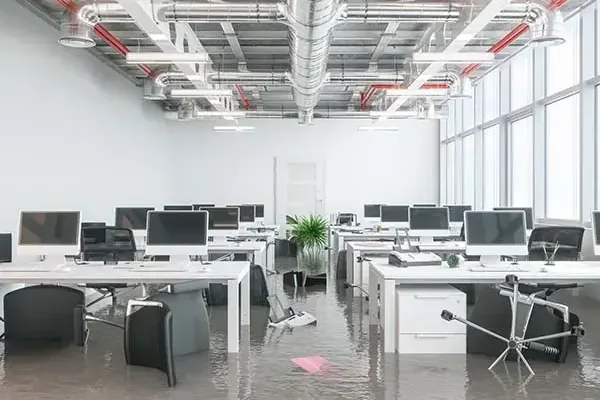
On September 17, 2024, a Boston Water and Sewer Commission main was damaged in Peabody Square, flooding the square. WBUR and the Dorchester Reporter reported that a utility crew working in the street apparently struck the main. The flood left a hole about 9 feet by 9 feet, and police closed the avenue through the square.
Key takeaways
- The September 17, 2024 main break flooded Peabody Square, left a hole about 9 feet by 9 feet and closed the avenue through the square.
- A road closure can stop customers and deliveries even when a business stays dry, so the loss may be more than the water itself.
- On day one: protect people, find the shutoff, photograph everything and start extraction before water spreads into walls and stock.
- Water that comes from a street or a public main is treated as contaminated until the restoration team says otherwise.
- Keep a written record of lost stock and closed days, because insurers ask for both.
What happened at Peabody Square in September 2024
On September 17, 2024, a Boston Water and Sewer Commission main was damaged in Peabody Square. WBUR and the Dorchester Reporter reported that a utility crew working in the street apparently struck the main.
The flood left a hole about 9 feet by 9 feet, and police closed Dorchester Avenue through the square. Another public main break closed part of Gallivan Boulevard on June 15, 2019, according to the Boston Globe.
Public breaks happen at different places, and a business owner cannot prevent them. What an owner can control is how fast the response begins.
Why a street closure hurts a shop even when the water stays outside
When police close a main avenue through a square, customers cannot reach the shops and suppliers cannot unload. A business can lose a day of sales without a drop of water inside.
If water does enter, the business faces both problems at once: cleanup inside and a blocked street outside.
- Customer access and parking.
- Deliveries of stock and supplies.
- Staff getting to work.
- Access for the restoration crew's trucks and hoses.
Day one for a shop or restaurant owner
The first day has two jobs, keeping people safe and building a record.
Protect people and power
Safety comes first, before stock and before the books.
- Move customers and staff away from standing water.
- Stay clear of wet outlets, cords, coolers and kitchen equipment.
- Shut off power to wet areas only from a dry panel.
- Close the water shutoff if the business has its own.
Record the loss
Insurers usually ask two questions: what did the water damage, and how long was the business closed? A recent inventory, photographs and sales records help answer both.
Coverage for lost income depends on the policy, so the records matter whatever the answer turns out to be.
- Photograph the waterline, the floor and the damaged stock.
- List the inventory that got wet, with quantities.
- Note the time the water was noticed and when the street was closed.
- Keep receipts for supplies and temporary help.
- A recent inventory with values.
- Sales records for comparable days.
- The dates the street was closed and the business was shut.
Why water from a street main is treated as contaminated
A main carries clean supply water, but water that crosses pavement picks up soil, oil and debris. Where drains overflow, sewage can join it.
The restoration team treats it as Category 2 or Category 3 under the IICRC S500 standard until the evidence shows otherwise. Food, packaging and fabric that touched it are usually discarded.
- Wet food and packaged stock: set aside for disposal, with photographs.
- Porous materials, such as carpet and ceiling tiles: usually removed.
- Hard floors and counters: cleaned and disinfected.
- Food-contact surfaces: cleaned and sanitized before food is handled again.
Extraction and drying in a storefront
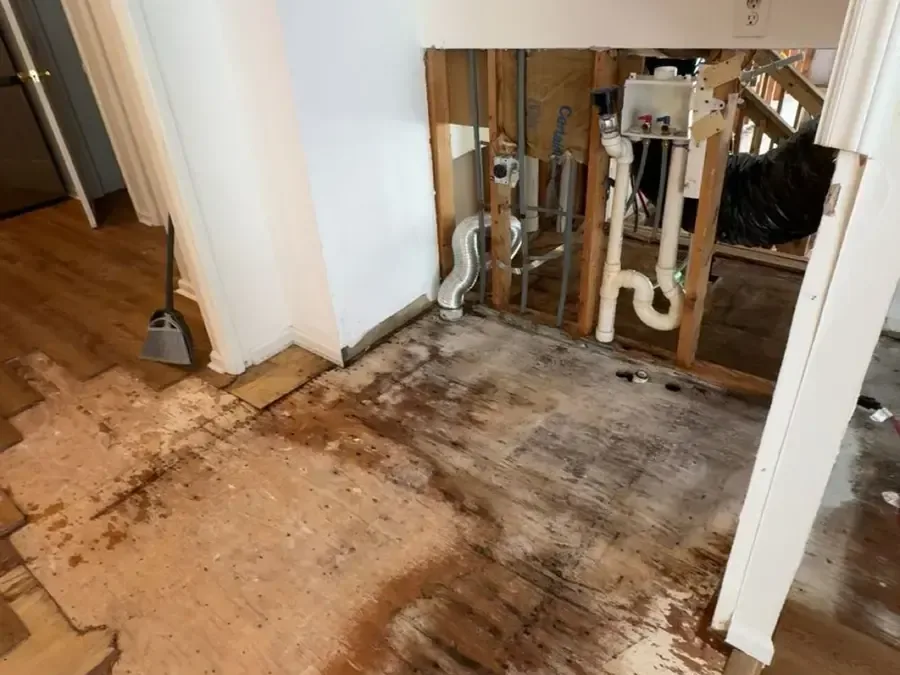
The extraction crew removes standing water with truck-mounted and portable units, working from the lowest point of the floor. Wet stock and fixtures are moved out first.
The work is described under commercial water damage and water extraction.
The drying team then maps moisture in floors, walls and ceilings, opens wet cavities and sets dehumidifiers and air movers. A commercial space often has large open floors, so equipment is placed in zones.
The drying stage is covered under structural drying.
- Ceiling tiles and insulation checked for water above.
- Floor coverings tested in a grid.
- Walls behind shelving and counters opened where readings are high.
- Equipment moved around as areas dry, so work can continue around a dry zone.
Reopening in stages and what to confirm first
A business does not always have to stay closed until every wall is dry. In some cases the sales floor tests dry first and can open while the back room finishes.
The restoration team can sequence the work around the zone the owner needs back first.
Before the crew starts, the owner can confirm how the job will run.
- Dry zones are tested and recorded in order.
- Work is scheduled around opening hours where possible.
- Equipment is placed to keep walkways and exits clear.
- That moisture readings will be taken and shared.
- How wet stock and fixtures will be handled and documented.
- How the work will be sequenced around opening hours.
- What the scope covers and what needs a separate estimate.
- Who will be on site and how the building is secured overnight.
Dorchester's business districts and water loss
The business districts at Uphams Corner, Fields Corner, Codman Square, Peabody Square, Adams Village and Lower Mills, along with the South Bay and Newmarket industrial area, hold shops, restaurants, offices and industrial buildings. A water loss looks different in each type of building, and the drying plan follows the construction.
More local detail appears on the water damage pages for the area.
Questions
Is a business covered when a street closure stops sales?
Coverage for lost income depends on the policy and the cause. Records of closed days and lost stock help whatever the policy says.
Can food and packaging be saved after a flood?
Food and packaging that touched street or sewage water are usually discarded. Sealed items that stayed above the water may be saved, and photographs of everything support a claim.
What should be photographed first?
The standing water, the waterline on walls and shelving, and the damaged stock. Wide shots show the room, and close shots show the damage.
How fast does water spread through a commercial floor?
Water moves quickly across open floors and wicks into walls, shelving and stock. That is why extraction starts before anything else.
Who caused the Peabody Square break?
WBUR and the Dorchester Reporter reported that a utility crew working in the street apparently struck the main. The cause is mentioned here only as reported.
Should a business stay open during cleanup?
Sometimes part of it can, if the area is dry and safe. The restoration team can separate wet zones from open ones and decide from the readings.