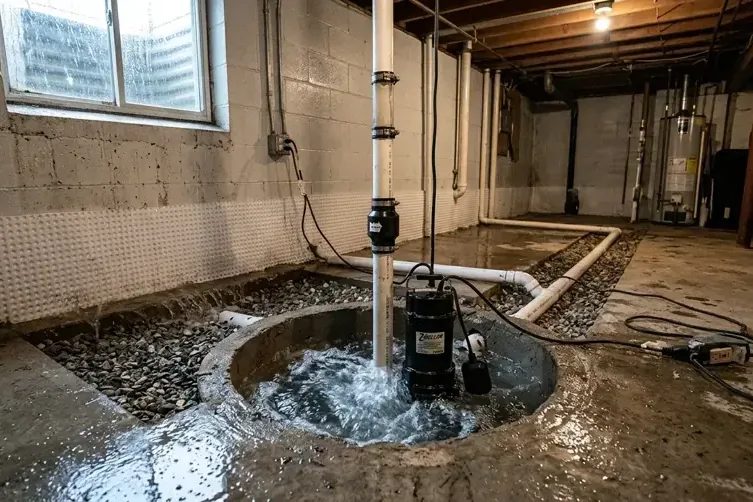
Most of the late-19th-century houses in Mission Hill stand on stone foundations cut from a large puddingstone quarry between Tremont Street and Alleghany Street. By the 1890s the hill was covered in triple-deckers, and the lowest level of those older buildings is where water from a leak, a storm or a backup tends to collect.
Key takeaways
- A large puddingstone quarry between Tremont Street and Alleghany Street supplied the stone foundations of most late-19th-century houses in the neighborhood.
- Stone and masonry hold moisture longer than wood framing, so readings, not the calendar, decide when drying is done.
- The City of Boston Flood Info page on Boston.gov serves residents of basement-level apartments, property owners and businesses, and links to flood maps.
- Clean water, storm water and sewage are handled differently, so the source is identified before anything is thrown away.
- Residents can report flooding with a City of Boston service request, and the Boston Water and Sewer Commission has a sanitary sewer overflow reporting option.
Mission Hill's stone-footed houses
A large puddingstone quarry between Tremont Street and Alleghany Street produced the stone foundations of most of the late-19th-century houses in the neighborhood. Some buildings near the corner of Tremont Street and Parker Street are made entirely of puddingstone.
The area is known for brick row houses and for triple-deckers. By the 1890s the hill was covered in triple-deckers, and Calumet, Iroquois and other streets with Native American names were built up as a dense neighborhood of Queen Anne style triple-deckers.
For water damage, the practical point is that the lowest level of most of those houses is masonry, and masonry behaves differently from wood once it gets wet.
How water gets into an older stone lower level
Stone foundations are built from many pieces set with mortar. Water can find its way through mortar joints, along the seam where the wall meets the floor and around pipes that pass through the wall.
A leak from above is the other path. Water from a burst pipe, a failed fitting or a ceiling above runs down through the floors of a triple-decker and ends up in the lowest level.
- Seepage through mortar joints and wall seams after heavy rain.
- A supply pipe or water heater failing inside the building.
- A drain or sewer backing up into floor drains and utility sinks.
- Window wells and exterior stairs that collect rain.
Clean water, storm water or sewage?
The source decides the cleanup. Clean supply water from a broken pipe can often be dried in place, while storm water and sewage carry contamination and change what must be removed.
When the source is unclear, the restoration team assumes the higher category until the readings and the path of the water show otherwise.
- Category 1: clean water from a supply pipe, an appliance or a tank.
- Category 2: water with some contamination, such as an overflowing washer or a sump pit.
- Category 3: sewage, floodwater from outside and anything grossly contaminated.
Where residents can report flooding and find city information
The City of Boston Flood Info page on Boston.gov serves residents of basement-level apartments, property owners and businesses, and it links to flood maps and an inundation model from the Boston Water and Sewer Commission.
Residents can report flooding by submitting a City of Boston service request, and the Boston Water and Sewer Commission has a sanitary sewer overflow reporting option. Reporting is separate from cleanup, which still needs to start quickly.
Extraction and drying in a stone-walled lower level
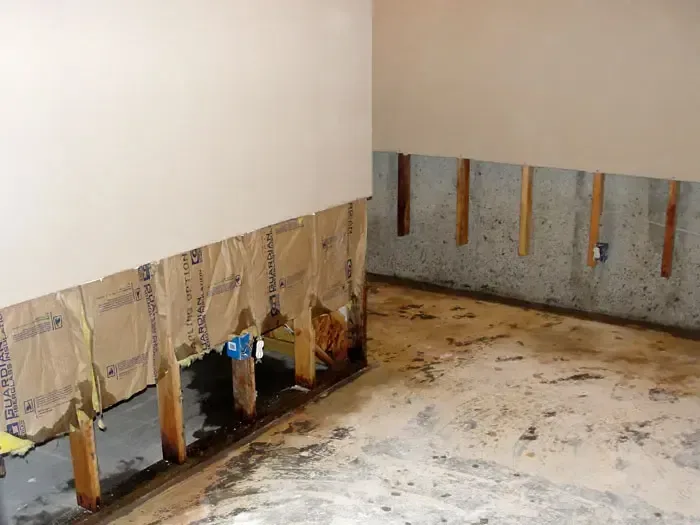
Stone walls change the drying plan, so the work starts with measuring and then moves to extraction and drying.
The first visit: measuring
The first visit is mostly measuring. The restoration team maps where the water went before any wall is opened.
Those readings become the baseline for the whole job. Each later visit is compared against them, which is how the drying team knows when stone and plaster have stopped giving up moisture.
- Moisture readings on stone, plaster, framing and floors.
- Thermal images that show cool, wet areas behind finished walls.
- The path of the water from the source to the lowest point.
- The water category, based on where it came from.
- A list of belongings and finishes at risk.
Getting the water out
The extraction crew removes standing water with truck-mounted and portable units, then lifts or removes finishes that trap water against the wall. The steps appear under water extraction and basement flooding cleanup.
Drying stone, plaster and wood
Masonry holds moisture longer than framing, so stone walls and plaster get extra readings. The drying team sets LGR dehumidifiers and air movers, then records moisture at each visit until the readings are close to a dry reference.
The method is described under structural drying.
- Stone and mortar: checked with moisture meters and surface readings.
- Plaster: checked for softening and staining.
- Wood framing and floor joists: dried in place when readings allow.
- Stored belongings: moved to a dry space before equipment is set.
Protecting the units above and what is stored below
In a triple-decker, one unit's water problem can become another's. A leak in the lowest level can raise humidity in the unit above, and a leak from above can drip into the level below.
Stored belongings are the part most often lost. Moving cardboard, fabric and electronics onto a dry shelf early limits the damage.
- Place plastic over furniture in the unit above if a ceiling or floor is wet.
- Check the ceiling and walls of the lowest level a day or two after the water is gone.
- Keep stored boxes off the floor once the space is dry.
- Tell the neighbors above and below, since water paths cross units.
A short checklist for a wet lower level
These steps keep the situation from getting worse while help is on the way. More local detail is gathered on the Mission Hill water damage pages.
- Shut off the source if it is a pipe or an appliance.
- Stay out of standing water near outlets, cords or the panel.
- Photograph the waterline, the floor and damaged belongings.
- Move cardboard, fabric and electronics onto a dry shelf.
- Note whether the water came from a pipe, a storm or a drain.
- Report flooding to the City of Boston if the cause is outside the building.
Questions
Is a stone foundation more likely to leak?
Stone walls are built from many pieces set in mortar, and water can pass through the joints and seams. That does not mean every stone-footed house leaks, but the joints are where seepage tends to show up.
Can plaster and stone dry after a flood?
Often yes, when the water was clean and the materials were not soaked for long. Masonry dries slowly, so readings set how long equipment runs.
What if the water came from a sewer drain?
Sewage is Category 3. Porous materials that soaked in it are removed, and hard surfaces are cleaned and disinfected. Only what stays is dried.
Where can a basement-level apartment resident find flood information?
The City of Boston Flood Info page on Boston.gov serves residents of basement-level apartments, property owners and businesses, and it links to flood maps.
Does puddingstone get damaged by water?
Puddingstone is hard stone, but the mortar between pieces and any plaster or wood on it can be damaged. The drying plan focuses on those materials.
How long does it take to dry a stone-walled lower level?
Often several days, and sometimes longer for thick masonry. The readings decide, because stone releases moisture slowly compared with framing.